Software Supply Chain Security
See Everything, Secure Everything
Core Challenges
Fragmented Visibility Creates Enterprise-Wide Risk
Third-Party Dependencies
SBOM Drift & Staleness
Scaling Across Applications
Alert Fatigue & False Positives
Incomplete Asset Visibility
Software Supply Chain Risk
Unknown Cryptographic Exposure
Continuous Compliance
Post-Quantum Readiness
Lack of Crypto-Agility
Fragmented Security Intelligence
Limited Executive Visibility
Qvoyant in Action
Qvoyant: One Platform, Unified Capabilities
Automated Discovery & Enrichment
Automatically discovers all direct and transitive dependencies with full metadata enrichment.
Continuous Monitoring
Real-time tracking of changes across environments with automated regeneration.
Vendor Portal & Email Links
Streamlined third-party SBOM collection through secure vendor portals.
Migration Strategy & Planning
Prepare for the quantum transition by planning algorithm migration (ML-KEM, ML-DSA) and tracking readiness.
Centralized Management
Single platform to manage SBOMs for unlimited applications and microservices.
Contextual Analysis
Intelligent filtering and prioritization based on actual exploitability.
Automated Enrichment
Al-powered metadata completion and validation.
Dynamic Configuration
Abstract cryptographic calls from application logic to swap algorithms via config parameters rather than code rewrite.
Native Pipeline Support
Seamless integration with GitHub, GitLab, Azure DevOps.
Secure Cloud/On-Premise
RBAC, versioning, and audit logs built-in.
Audit-Ready Reports
Pre-built compliance reports for CERT-In, SEBI, RBI requirements.
Coexistence & Interoperability
Run classical and quantum-safe algorithms together in TLS 1.3 to ensure backward compatibility during transitions.
Software Supply Chain
Master Your Software DNA (SBOM)
Automated Discovery
Don't rely on spreadsheets. We auto-discover dependencies from your repos, containers, and build artifacts.
Vulnerability Context
Not all CVEs matter. We check if the vulnerable function is actually reachable in your code.
Policy Guardrails
Automatically break the build if a developer introduces a critical vulnerability or a restricted license.

Universal Ingestion
Connect GitHub, GitLab, Docker, JIRA, or upload SPDX/CDX files. We normalize all data into a single source of truth.

Deep Analysis
Correlate components with CVEs & malware. Our engine identifies reachability to prioritize what actually matters.

Enforce & Report
Block non-compliant builds. Auto-generate reports for RBI/SEBI audits with one click.
Cryptographic Supply Chain
Future-Proof Your Cryptography (CBOM)
Cryptographic Inventory
Automatically catalogue all cryptographic algorithms, keys, and certificates present across your entire application portfolio.
Weak Algorithm Detection
Pinpoint outdated hashing and encryption methods (like MD5, SHA-1, RSA-1024) that leave your company's data exposed.
Post-Quantum Readiness
Assess your vulnerability to quantum computing attacks and build a migration path to NIST-approved PQC standard algorithms.
Quantum Readiness
Post-Quantum Cryptography (PQC) Migration Planning
Sovereign India Roadmaps
Global & EU CRA Compliance
Crypto-Agility Abstraction
Interactive Sandbox
BOM Compliance & Crypto Radar
Discovered Software Components
openssl-crypto
v1.1.1u
Cryptographic library providing fundamental algorithms. Standard open-source scanners miss critical metadata fields. Qvoyant provides full 21-field validation.
Critical EOL & Reachable Cryptographic Weakness
OpenSSL 1.1.1 has reached End-Of-Life (September 2023) and is running quantum-unsafe RSA-2048 primitives that are actively invoked inside authentication pathways.
lodash
v4.17.20
Utility library used in front-end and back-end logic. Often carries transitively introduced security vulnerabilities.
Reachable Analysis: Suppressed Vulnerability Alert
Lodash version contains CVE-2020-8203, but reachability diagnostics confirm the vulnerable function is not invoked by your code. Safe to suppress (saves audit hours).
react-dom
v18.2.0
Core React package for DOM rendering. Scanned directly from dependency manifest with fully resolved provenance checks.
100% Schema Validation Compliance
React DOM successfully maps all 21 CERT-In mandatory elements. Provenance signature is verified against official npm registry records.
Discovered Cryptographic Assets
Quantum Vulnerability Assessment
NIST and the DST National Quantum Mission mandate transitioning asymmetric crypto keys to post-quantum safe primitives. Standard public key encryption will break within this decade.
2027: Discovery & Inventory
Identify all classical algorithms via CBOM discovery (NQM Target).
2029: Critical Infrastructure Migration
Transition Indian banking, defense and key sectors to hybrid models.
2030: Quantum Break-Year Threat Window
Estimated window for cryptographically-relevant quantum computers to break RSA keys.
Built for Local & Global
Compliance Without the Chaos
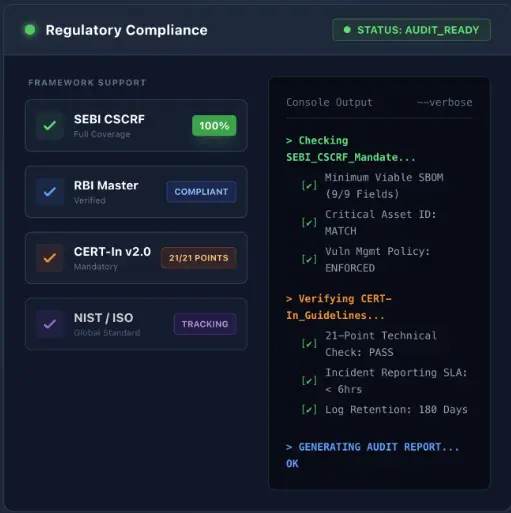
Stop struggling with spreadsheets and manual evidence collection. Qvoyant is purpose-built to map technical findings to specific global regulatory line items.
RBI Master Directions
Automated "Vendor Risk" assessments and "Criticality Analysis" for banking applications.
SEBI CSCRF
Real-time vulnerability tracking and "Minimum Viable SBOM" generation for Market Infrastructure Institutions.
CERT-In Guidelines
Incident readiness with instant "Impact Analysis" reporting when new CVEs drop.
Seamless Ecosystem
Works Where You Work




Testimonial